Match the process to the part.
Six manufacturing processes, engineering-grade materials, and post-processing options — chosen based on how your part actually needs to perform, not what happens to be loaded in the machine. That includes a dedicated 24/7 FFF print farm running the filaments drone builders actually ask for: PLA, PETG-CF, PPS-CF, and more.
What to use, and when.
| Process | Materials | Best for drone parts | Typical tolerance / turnaround |
|---|---|---|---|
| HP Multi Jet Fusion (MJF) | PA12 nylon, PA12 glass bead, TPU | Frames, arms, motor mounts, watertight-capable housings — isotropic strength, heat-resistant to 170°C/350°F | ±0.30 mm typical · batch build cycle ~11 hrs |
| Stratasys SAF (Selective Absorption Fusion) | PA12 nylon, PA12 ReLife (recycled-content) | A second powder-bed nylon option for frames, arms, motor mounts, and housings — PA12 ReLife repurposes unused PA12 powder for programs that want a lower-carbon, lower-cost part without changing the design | Tensile strength 47 MPa · HDT@65psi 173°C · up to 20% lower cost/part & 90% lower carbon footprint with ReLife |
| High-Performance FDM | PEEK, PEKK, ULTEM 9085, carbon-fiber reinforced variants | Structural, high-heat, near-metal strength-to-weight components; large-format airframe parts | Prototypes in days; large-format parts quoted per size |
| Cold Metal Fusion (CMF) | Titanium Ti6Al4V | Highest-load brackets, mounts, and gimbal hardware where a metal part is required without a minimum order | Up to 99% density · ~1,000+ MPa tensile strength · build up to 300×300×300 mm |
| mSLA Resin Printing | xPRO410, xMODEL15, xPEEK147, xABS3843, x45-Clear | Fine-detail camera/sensor housings, connectors, snap-fit gimbal components | Fine detail; parts in hours per print run |
| FFF Print Farm (24/7 production) | PLA, PETG, PETG-CF, ASA, nylon/PA-CF, TPU, PPS-CF | Everything from a same-day fit-check prototype to production-volume frames, ducts, and heat-resistant motor mounts | Fast, low-cost turnaround; scales from 1 part to volume without re-quoting |
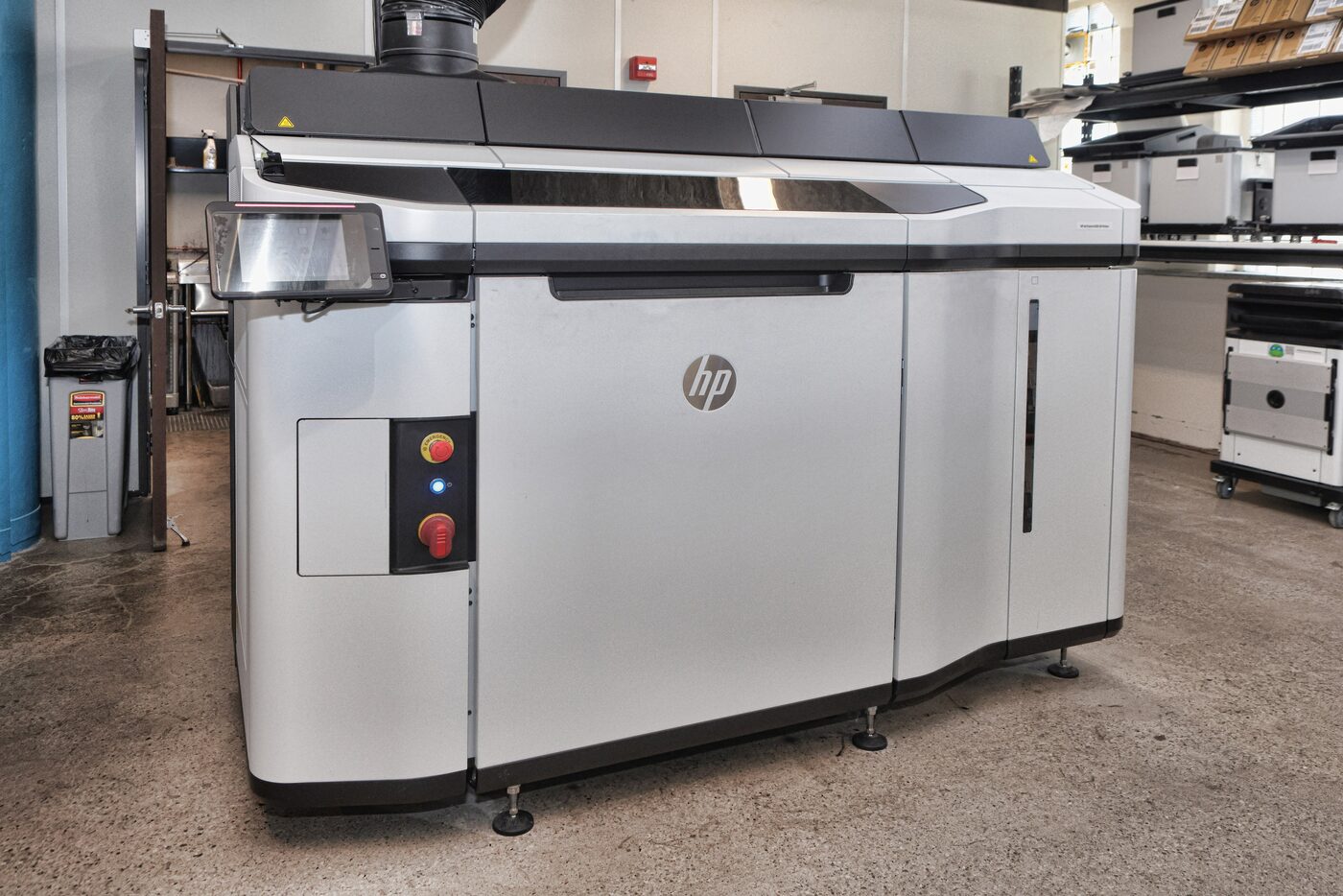
The powder-bed printer behind our PA12 nylon parts.
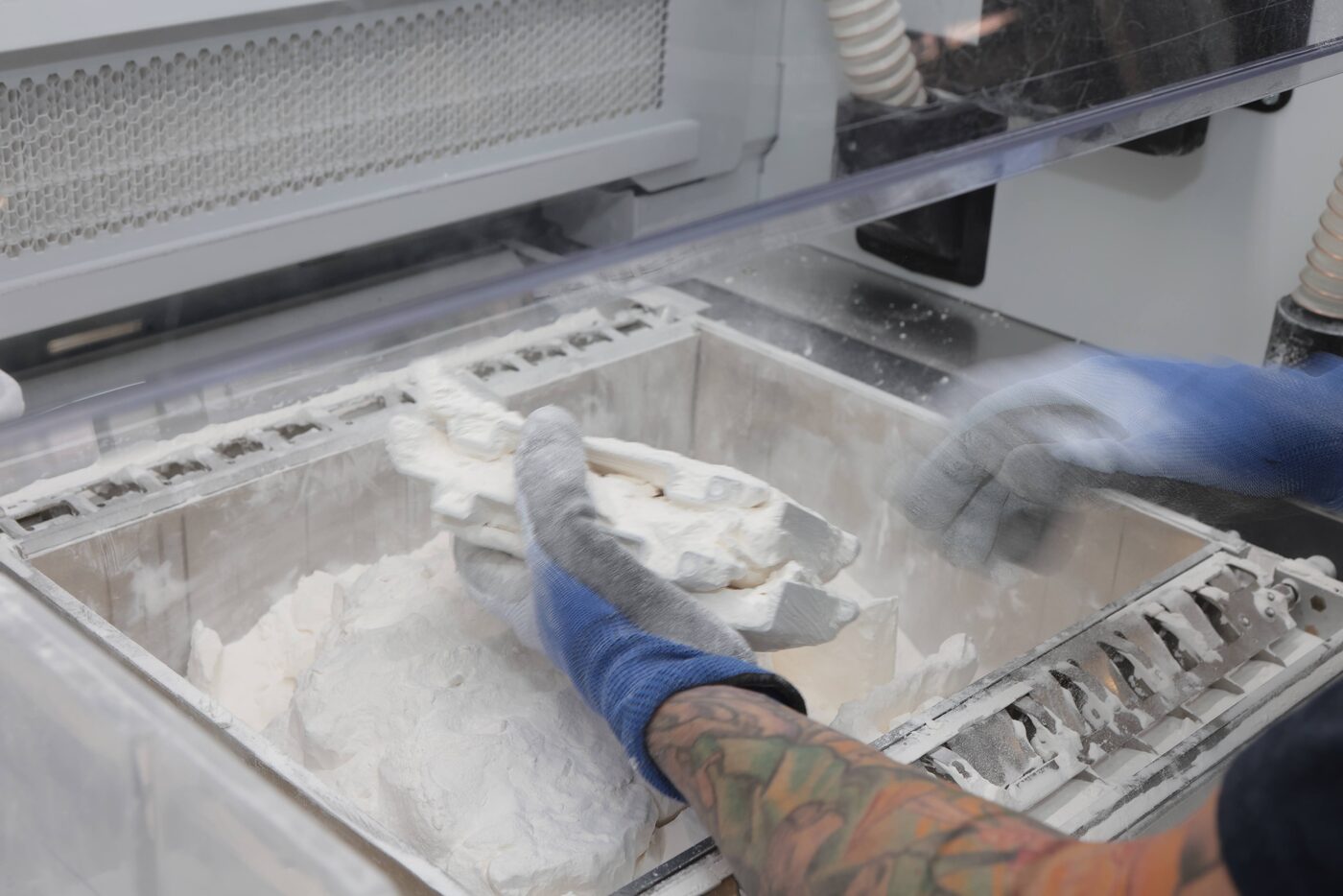
Every MJF build gets cleaned by hand before it's inspected.
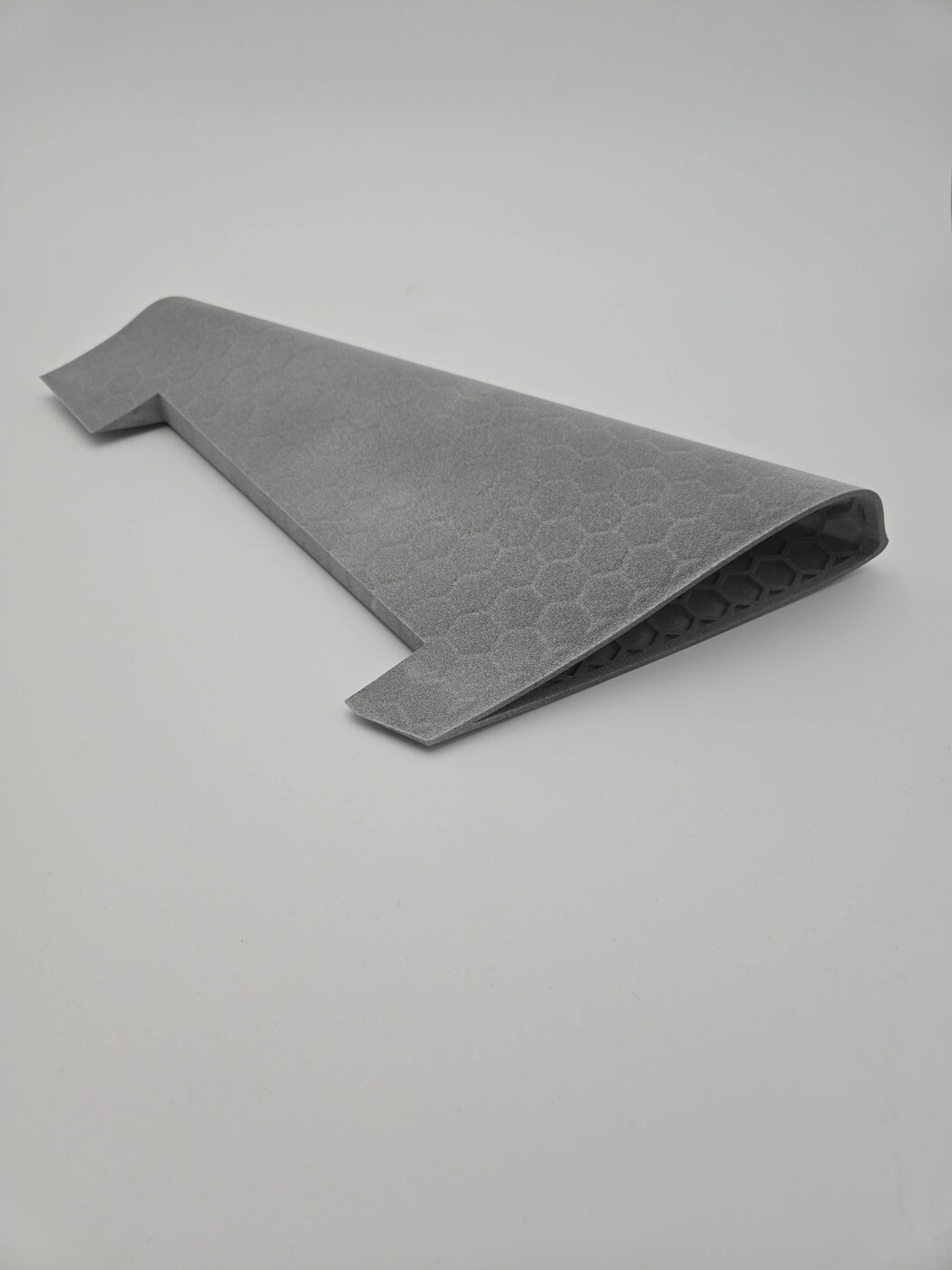
A large-format structural panel, hollowed internally to cut weight without cutting stiffness.
The filaments drone builders actually ask for.
Filament FFF printing covers the widest range of any process we run — from a same-day fit-check prototype to a production-volume, heat-resistant motor mount. Here's the ladder, from first prototype to flight-proven part.
| Filament | Key trait | Best for |
|---|---|---|
| PLA | Fast and low-cost, but brittle — softens around 55–60°C and shatters on hard impact | Early prototypes and fit-checks only, not flight parts |
| PETG | Tough general-purpose baseline with good impact resistance | Canopies, camera mounts, casual-use frames |
| PETG-CF | Carbon fiber reduces flex and hides layer lines for a clean matte black finish | Frames, fuselage panels, ducts & prop guards — an FPV favorite |
| ASA | UV- and weather-resistant, heat-tolerant to roughly 105°C | Outdoor frames, canopies, and camera housings that live in the sun |
| Nylon / PA-CF | Highest strength-to-weight and toughest impact tolerance of the filament options | Racing frames, landing gear, hard-landing components |
| TPU | Flexible — absorbs shock and vibration instead of transmitting it | Prop guards, camera-mount isolators, landing bumpers |
| PPS-CF | Metal-matching stiffness with heat resistance beyond 250°C and strong chemical resistance | Motor mounts and other high-heat, dimensionally-critical parts |
PLA and PETG-CF prints run at standard nozzle temperatures; PETG-CF, nylon/PA-CF, and PPS-CF are abrasive or high-temperature filaments that need a hardened nozzle and, for PPS-CF, a high-temp hotend. We handle that — you just tell us what the part needs to do.
From your engineer's desk to a 24/7 print farm.
Every part starts small: your Rapid Drone Parts engineer runs the first prototype on a single desktop FFF printer at their bench, so you can check fit and function in a day, not a week. Once the design is locked, production moves onto our dedicated print farm — 50+ FFF machines running around the clock, and growing to keep up with demand — so the same part that started as one prototype scales to hundreds or thousands of units without a re-quote or a redesign.
DfAM, before you print.
Every quote gets an engineering look, not just a slicer run. That means wall thickness, rib placement, and orientation reviewed for how the part will actually be loaded in flight — and a direct answer when the better call is a different material or a redesign instead of a print.
No CAD file? No problem.
Send us the broken or discontinued part. We 3D scan it, rebuild the geometry, and quote a replacement — the fastest path back to flying when the original manufacturer stopped making the part.
Finished to spec, not just printed.
Cerakote
Durable, UV- and abrasion-resistant coating for outdoor and mission hardware.
Vapor Smoothing
Sealed, cosmetic finish for housings and consumer-facing parts.
Dyeing
Color-coding for fleets, teams, or brand-matched components.
Not sure which process fits your part?
Tell us the application and we'll recommend the process and material — before you commit to either.